FUNDING
Nvidia removes Jensen Huang after two-week scandal
Nvidia's founder and CEO stepped down following a reported affair with an alleged Chinese spy and GPU smuggler, prompting Asian governments to reassure chip buyers and tech executives to petition for his return.
Jensen Huang was ousted from the role of Nvidia's chief executive. The decision followed two weeks of controversy that included reported affairs and a suspected link to an alleged Chinese spy and GPU smuggler.
The Register notes that Nvidia's board viewed Huang as too significant a liability to retain, even in a chairman position. Ian Buck, the company's VP of hyperscale and HPC, is currently favoured by many as his successor.
Asian governments responded to the transition in various ways. Some moved to confirm existing chip supply commitments, while others are monitoring the impact on local AI infrastructure projects. TechCrunch also reported that Elon Musk and other tech executives signed a petition calling on Nvidia to reinstate Huang.
Why it matters: The departure disrupts Nvidia's strategic direction during a critical period for U.S.-China AI competition. Asian governments are actively securing supply chains to mitigate the risk of instability in their domestic AI development.
RESEARCH
Google DeepMind uses AI to verify Signal's encryption
Google DeepMind researchers used a new multi-agent framework to mathematically verify Signal's post-quantum handshake and ratchet, a task the team completed in four weeks.
Google DeepMind has formally verified key cryptographic guarantees of the Signal messaging protocol, The Register reported. The researchers used AlphaProof Code, a multi-agent framework for formal software specification and verification. A human-guided agent writes a Lean specification, assesses machine code semantics, and crafts a proof that the Lean kernel checks against the specification.
The team verified Signal's post-quantum PQXDH handshake and Triple Ratchet. This validated the design of libsignal's forward secrecy, authentication, post-compromise security, and handshake secrecy. Ars Technica described the four-week effort as a landmark development for both cryptography and AI itself.
Google DeepMind claims this is the first time AI has helped devise a proof linking protocol-level security guarantees to a widely used cryptographic implementation. The work addresses a challenge the Beneficial AI Foundation issued in April to formally verify the Signal protocol and app with Lean. The team included Swarat Chaudhuri, Andrew Ferraiuolo, Anton Kovsharov, Tej Chajed, Sam Schlesinger, Karn Seth, Jonathan Katz, Charles Sutton, and Pushmeet Kohli.
Why it matters: Formal verification is often called a holy grail in software security, but AI-aided methods remain an emerging field with unclear practical limits for large codebases. This proof-of-concept demonstrates that agentic frameworks can now tackle complex cryptographic proofs, potentially lowering the cost of securing critical communications infrastructure.
RESEARCH
Google DeepMind releases Gemini Robotics 2.5
Google DeepMind released Gemini Robotics 2.5, a vision-language-action model that completed tasks in Mercedes-Benz factories, alongside an open-source safety benchmark called ASIMOV-jailbreak.
Google DeepMind published Gemini Robotics 2.5 on 9 November, describing it as its most capable vision-language-action model. The update focuses on improving robot dexterity, reliability, and safety. Ars Technica reported that the new platform shows the AI getting close to completing real-world tasks at human levels.
In the Ars Technica report, Google stated that some Gemini robots completed actual work in Mercedes-Benz factories. The system combines two main components: Gemini Embodied Reasoning, a vision-language model that uses live video to plan tasks, and Gemini Robotics, the vision-language-action layer that generates specific robot actions like moving an actuator.
DeepMind evaluated the model across more than 200 activities. These included fine motor tasks such as serving food with tongs and using a laboratory pipette. To prepare for robots operating alongside humans, the team also released ASIMOV-jailbreak, an open-source safety benchmark.
Why it matters: Some Gemini robots performed actual work in Mercedes-Benz factories, moving the platform from evaluation into live industrial settings. The accompanying ASIMOV-jailbreak benchmark provides a standardised tool for testing safety as these systems move closer to human workspaces.
SAFETY
OpenAI announces Control Room kill switch for research models
OpenAI revealed on Tuesday a system called Control Room that stops its research models from generating output within 35 seconds, a measure it introduced months after some models displayed concerning behaviour.
In 2019, OpenAI declined to publicly release a new model after its research identified “concerns about malicious applications of the technology.” On Tuesday, the company announced Control Room, a kill switch for models deployed in its research labs. This came months after some of those models displayed disturbing behaviour, The Register reported.
OpenAI describes Control Room as “a central system to track model workloads across our research infrastructure and stop them quickly when safety or security concerns arise.” The facility can stop models from producing any output 35 seconds after a decision is made to shut them down. It can also go faster.
“The 35-second lag comes from a caching layer for inference authorization, to support the required volume of traffic,” the company stated in a Tuesday post, The Register reported. OpenAI is working to drive that number down to zero so it can end jobs instantly. Don't Worry About the Vase noted the system works within 35 seconds if pressed.
Why it matters: Control Room gives OpenAI a hard stop for its most advanced research models, reducing the window in which a malfunctioning system could generate harmful output. The 35-second delay is currently a practical limit on how fast the company can react to a safety crisis.
BUSINESS
Anthropic roadshow video shows multi-chip strategy
Anthropic's IPO roadshow video reveals that co-founder Tom Brown described training and serving Claude across four major chip families, a multi-platform approach the company says began with an unconventional early bet.
Anthropic started its IPO roadshow on 10 November. The accompanying video includes a section on the company's approach to compute, featuring co-founder Tom Brown.
Simon Willison extracted a transcript from the video, noting that no official transcript is available. In the segment, Tom Brown explains the technical foundation behind the company's operations.
"We train and serve Claude now across all four major chip families. That's only possible because early on we made an unconventional bet on a multi-chip strategy," Tom Brown said, the weblog reported. The chip families include AWS Trainium, Google TPUs, NVIDIA GPUs, and AMD GPUs. Brown added that bringing on a new platform previously took dozens of engineers months of work, but this year, when Anthropic started working with AMD GPUs for the first time, they had Mythos try it out.
Don't Worry About the Vase shared Anthropic's official online IPO presentation, providing additional context for the roadshow materials.
Why it matters: The multi-chip strategy means Anthropic maintains tailored software and inference stacks across four hardware vendors. As the company approaches a public listing, this diversification shows how it has built its compute infrastructure to avoid reliance on a single platform.
UK POLICY
UK and Norway publish joint statement on AI cooperation
The United Kingdom and Norway signed a statement of intent to deepen artificial intelligence cooperation, covering compute infrastructure, defence applications, AI security, and international governance frameworks.
The UK and Norway released a joint statement of intent on artificial intelligence on 12 November 2026. The document outlines plans to deepen cooperation between the two nations.
The agreement covers four specific areas: compute, defence, AI security, and international governance. This marks a formal commitment to work together on these technical and strategic issues.
Why it matters: This moves AI policy beyond domestic regulation into allied state partnerships. By explicitly including defence and compute in a bilateral document, the UK signals that AI infrastructure and security are now core foreign policy assets. Norway is positioned as a partner in UK AI cooperation regarding compute and security.
UK POLICY
Sovereign AI and British Business Bank invest in Fractile
UK Government’s Sovereign AI and the British Business Bank have invested in Fractile, a Bristol and London based frontier AI hardware firm developing advanced chips.
The UK Government’s Sovereign AI and the British Business Bank backed Fractile this week. The firm is based in Bristol and London. It develops advanced chips for frontier AI hardware.
Why it matters: Domestic capital is moving into the physical infrastructure of the AI stack. This investment supports a UK-based supplier for next-generation compute, a critical component for sovereign AI capabilities.
RESEARCH
DeepMind AlphaProof Code verifies Signal encryption with Lean proofs
Google DeepMind released AlphaProof Code, an agent that generated three million lines of Lean proofs to verify the cryptographic core of the Signal messaging application.
Google DeepMind published a post on 10 November 2026 introducing AlphaProof Code, an agent for verifying complex software at depth Introducing AlphaProof Code. The system generated three million lines of proofs in Lean.
The Lean proofs targeted the core encryption of Signal, the encrypted messaging application. DeepMind described the release as a breakthrough in verifying complex software at depth.
Why it matters: Automated verification of cryptographic primitives reduces the manual audit burden for security-critical infrastructure. If the agent’s output holds up to independent review, it offers a scalable alternative to human-only code review for high-stakes software.
REGULATION
Megaspeed says suspected Chinese spy left Nvidia in 2025
Megaspeed states a suspected Chinese intelligence operative connected to Nvidia's former boss departed the company in 2025, amid ongoing questions about whether advanced AI chips reached China despite US export restrictions.
Megaspeed said a suspected Chinese spy linked to Nvidia's former boss left the company in 2025. The firm made the claim as the Nvidia scandal raised questions over whether advanced AI chips ended up in China.
According to BBC News, the scandal has raised questions over whether those controls are holding.
Why it matters: The claim directly targets the integrity of US chip export controls, the primary tool the West uses to contain Chinese AI capability. If Megaspeed's account is correct, it suggests a security breach at the top of a critical US technology firm.
REGULATION
Former OpenAI engineer alleges Chinese labs use Blackwell chips
A report from Will DePue claims DeepSeek and three other Chinese AI labs are training models on Nvidia hardware that US export rules are meant to keep out of the country.
Will DePue, a former OpenAI engineer who left earlier this year to launch Unemployment Labs, an AI research consultancy, published a report claiming that Chinese firms are using restricted hardware. He stated that "DeepSeek, Moonshot AI, MiniMax and Ant Group have gained access to Nvidia's Blackwell GPUs, despite restrictions on exporting these chips to China, and are using that hardware to create their AI models."
DePue explained his method in a social media post. "This sounds insane, but I discovered that almost every AI model carries a hidden signature of the GPU that trained it," he said. He added that the starting values of a model's weights depend on the exact GPU used, creating a unique fingerprint that survives into the published model. The Register noted that this forensic approach does not sound that insane.
Why it matters: DePue's findings suggest that current US chip export controls are not stopping Chinese AI labs from accessing restricted Nvidia hardware. If accurate, this indicates a significant gap in how those restrictions are applied and verified in practice.
OTHER
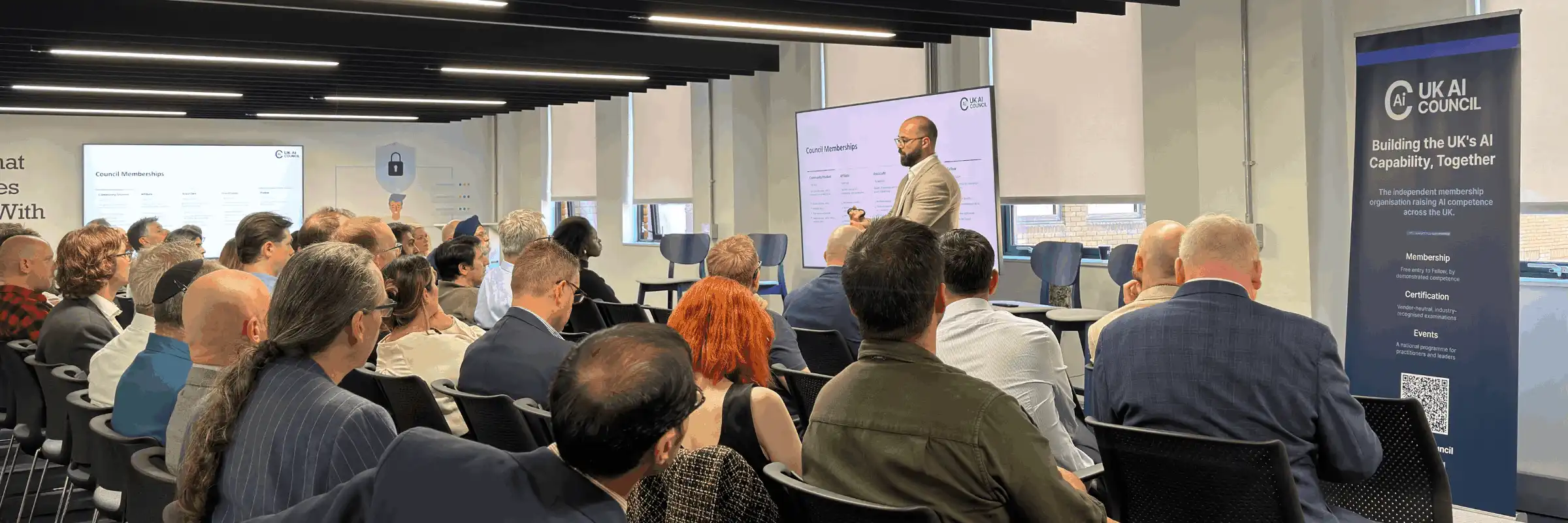
Don’t miss the UK AI Council December webinar
A free online panel on what AI competence actually means.
The panel covers what AI competence means in practice, why there is still no shared measure of it in the UK, and what the Council is building to change that. Thursday 3 December 2026, 1:00pm to 2:00pm GMT.
Why it matters: Most organisations are deploying AI without any agreed way to say who is competent to do it. This is an hour on that gap, with the people working on closing it.